Are There Sharks In The Whitsundays?
- Written by Allie Brown
- Last Updated August 24, 2026
To put it simply, yes – there are sharks in the Whitsundays.
It’s hardly surprising when you consider the Whitsundays are the gateway to some of the most expansive marine habitats on the planet.
To be honest, it would be a worry if there weren’t sharks in the region. The Great Barrier Reef and surrounding shoals, islands and coastlines are amongst the most pristine environments in the world and as such they’re home to a vast array of sea life. But rest assured that despite a decent chance of seeing a reef shark or other species, the likelihood of being attacked by one is extremely remote.
How Common Are Shark Sightings?
Shark sightings are relatively common in the Whitsundays, particularly if you are visiting the reef areas.
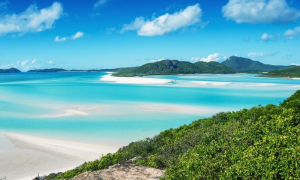
For most people, seeing sharks is actually one of the highlights of a visit to the region. However, not all sharks are the same, with the vast majority of shark species being non-threatening and typically scared of people. The places you are most likely to see a shark are in reef areas, such as when snorkelling at Hardy Reef, or in the shallow waters of Whitehaven Beach and Hill Inlet.
What are the Most Common Shark Species?
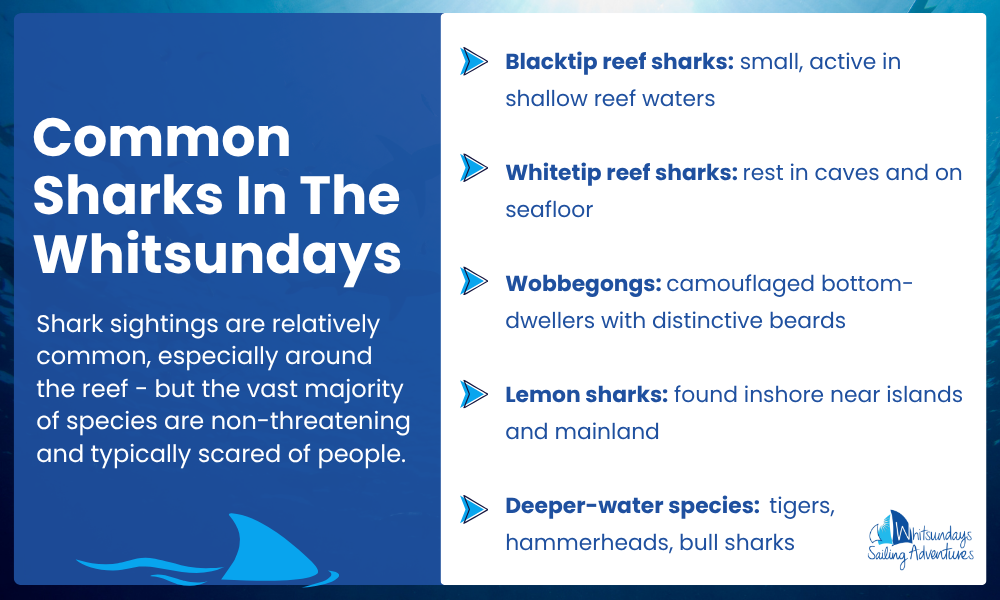
The most common shark species in the Whitsundays are blacktip reef sharks, wobbegongs, whitetip reef sharks and lemon sharks. These can be encountered in the inshore and shallower waters close to islands, along the reef and near the mainland. In the deeper waters off-shore you may see tiger sharks, hammerheads and bull sharks.
Blacktip reef sharks are small and quite active in shallow waters and reef habitats. They are easily identifiable by the black marks on their fins. Whitetip reef sharks look similar to blacktip, only the fins have white edges. They are generally found on reefs, hiding in caves and resting on the seafloor. Wobbegongs are strange looking critters, with beards and camouflage that helps them remain unseen on the seafloor.
How Common Are Shark Attacks on the Whitsundays?
Shark attacks in the Whitsundays are very uncommon. There was a small cluster of attacks in 2018 and 2019 that received a lot of media coverage, but these can be considered a rare anomaly.
Since then, there has been an increase in education and awareness campaigns to help mitigate against anything occurring again. Statistically speaking, you are more likely to be struck by lightning than attacked by a shark.
When is Peak “Shark Season” on the Whitsundays?
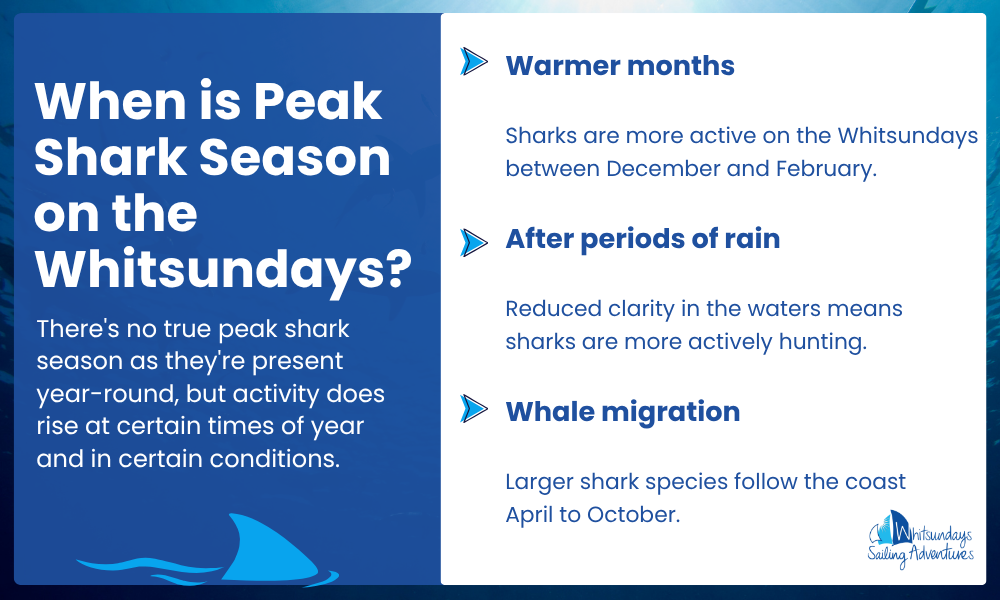
Technically, there is no peak shark season in the Whitsundays as they are present year-round.
That said, sharks are more active in the warmer months from December to February. This is when their metabolism is increased and the wet season rains reduce water clarity of inshore areas. The reduced visibility means they can hunt better and the inland rain and floods push out the estuarine species that they can then feed on.
Further offshore, the larger shark species like tiger and bull sharks can be more active as they follow the whale migration up and down the coast from April to October.
How to be Shark Smart on the Whitsundays
Being shark smart is a lot like being Crocwise. It’s all about understanding when the high-risk times are, where the more dangerous environments may be and being aware of your surroundings when in the water.
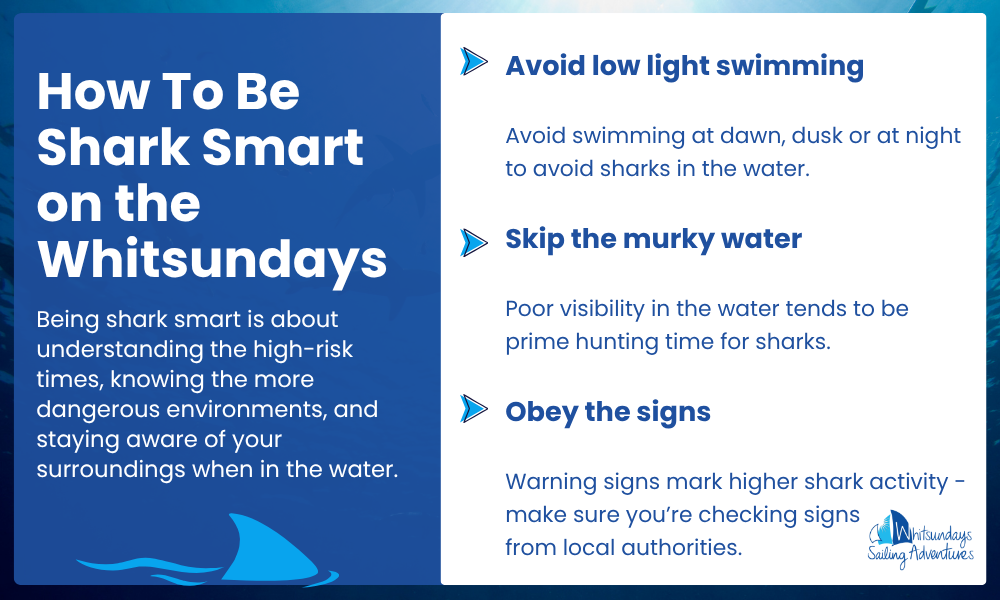
1. Avoid swimming at dawn, dusk or night
Sharks are actively hunting at dawn, dusk, and in the evening. These lowlight periods make it hard for you to see them and them to see you. So while sharks don’t typically ‘hunt’ people, they may mistake you for their normal prey. Instead of swimming in the ocean at these times, use a resort pool!
2. Do not swim in murky, deep or turbid water
Stay away from murky or turbid water – particularly near river mouths and commercial fishing or cleaning operations. Also, it’s best not to swim after periods of heavy rain. Like lowlight periods mentioned above, water where the visibility is poor due to tidal changes, depth or rainfall, are habitats where sharks will hunt. The murky water allows them to ambush their prey and if you’re unlucky enough to be mistaken for a fish or turtle, then you may get bitten.
3. Obey local signage – it’s there for a reason
Many areas like river mouths and inlets, and places where fish are cleaned, can attract increased shark activity and local authorities will typically provide warnings or ban swimming in these places.
Why Are There So Many Sharks in the Whitsundays?
The Whitsundays have a healthy shark population because the islands sit in the heart of the Great Barrier Reef Marine Park. This is a healthy, vibrant, protected habitat with plenty of fish and other sea life, warm tropical water, and safe, shallow nurseries for sharks to breed.
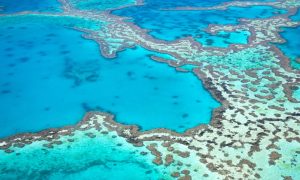
One of the things that makes the region so beautiful and attractive to tourists and sharks alike are the fringing coral reefs that are found in and around the 74 islands. They attract massive schools of baitfish and marine life, which are natural food for larger predators – like sharks. So while we love to see all the fish and explore the colourful coral gardens, so too do the sharks, for their own reasons.
The shallow marine areas like Whitehaven Beach, particularly at the northern end and Hill Inlet, offer safe, warm zones for juvenile reef and lemon sharks to grow. It’s a habitat where there’s access to food and shelter, with minimal threat from larger predators.
When it comes to the larger varieties like tiger sharks and bull sharks, the Whitsundays lie within their natural migratory pathways. These species travel through open ocean channels and currents, follow whale migrations and use island inlets as part of their regular coastal ranges.